news & Insights
Our FY2026–FY2028 Strategic Plan: Build Power. Move Money. Change Policy.
4 Steps for sustainable community transformation
The Center for Neighborhoods FY2026–FY2028 Strategic Plan sets the direction for our work over the next three years and sharpens how we turn neighborhood leadership into lasting change.
The plan starts from a simple truth: neighborhood transformation doesn’t happen because residents are asked to “show up.” It happens when people have the knowledge, relationships, resources, and authority to act—and when systems stop blocking progress. This strategy is built to do exactly that.
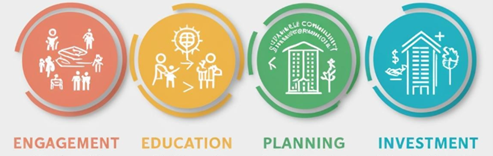
Grounded in CFN’s long-standing Theory of Change—Engagement → Education → Planning → Investment—the plan focuses our work on moving communities along that continuum, whether they engage at one stage or walk with us through all of them.
We start by connecting people through civic education and engagement—so residents become informed, organized, and confident about how change actually works.
Then we do what too few organizations can: we turn vision into action by walking alongside communities as they plan, finance, and implement neighborhood projects.
And we don’t stop there. We work to ensure communities don’t just participate in change—they shape the policies that sustain it.
Priority 1: Education & Engagement — grow neighborhood leadership at scale
Our core offering that attracts and equips stakeholders through structured leadership and technical education programs. We’re expanding the pipeline of residents and partners who know how change actually gets done.
This steady drumbeat of education programming ensures that community members are continuously involved, building a pipeline for deeper engagement. As participants gain knowledge and leadership skills, their interests naturally evolve, creating demand for more specialized education, as well as follow-on projects in planning and economic development. This cyclical approach sustains long-term community transformation and strengthens the organization's impact.
Priority 2: Planning & Investment (Economic Development) — turn community vision into real projects
Communities don’t lack ideas. They lack the bridge between vision and capital. That’s where we operate.
Our role as a neighborhood planner involves assisting communities in developing vision plans, land use strategies, and economic development roadmaps that align with resident priorities. Our investment work enables communities to mobilize resources effectively and implement transformative projects such as affordable housing initiatives, small business incubators, and public space revitalization efforts. By leveraging our expertise and partnerships, we help community-driven solutions receive the funding and support they need to succeed.
Our Economic Development work supports residents and organizations through neighborhood planning, project development, financing strategies, and implementation support. But more critically, we serve as a bridge—linking community groups with developers, government, philanthropy, and other capital partners to unlock real investment.
Example: Community-Led Neighborhood Transformation in Park Hill/Algonquin
A fully funded demonstration of our engagement, planning, and investment approach is our ongoing work in the Park Hill and Algonquin neighborhoods. This project exemplifies how community-driven visioning, coupled with strategic investments, can catalyze meaningful transformation. Through deep engagement with residents, collaborative planning sessions, and targeted investment strategies, we are working alongside these communities to improve infrastructure, economic opportunities, and social cohesion.
This initiative serves as a model for how our organization can tailor its expertise to meet the unique needs of diverse neighborhoods, ensuring that transformation is led by the people who live there. By securing sustainable funding, we can expand this effort, applying lessons learned to other communities seeking to follow a similar path to revitalization.
Priority 3: Policy — lock in wins so they last
If the rules don’t change, neighborhoods keep fighting the same battles. Policy is how we stop repeating the cycle.
We’ll use what we learn in neighborhoods to drive civic and legislative action—and expand tools like CivicPulse that make policy more transparent and usable for residents.
A new model for real change
share this

Be Part of
the Story
The stories you’re reading are powered by residents building stronger communities. Donate today and support our residents, plans, and partnerships that make community-led change possible.