
news & Insights
CivicPulse Update: Tracking the Decisions that Shape Louisville's Neighborhoods
Louisville spends more than $1 billion a year.
That money shapes daily life in every neighborhood. It repairs streets, funds departments, supports public safety, pays for parks, invests in housing, moves through neighborhood grants, and determines which public services residents can actually count on.
But most residents never really see where the money goes.
That is not because they do not care. It is because local government is hard to follow by design and by habit. The information is technically public, but it is scattered across long agendas, committee meetings, budget documents, ordinances, resolutions, zoning cases, amendments, and databases that were not built for everyday people.
A Metro Council agenda may run 40 pages. A key meeting may start at 6 p.m. on a Thursday. A bill may be introduced one week, referred to committee the next, amended later, and voted on with little public understanding of what changed or why it matters.
That is where CivicPulse comes in.
CivicPulse is a program of Center for Neighborhoods designed to track what Louisville Metro Council is doing — legislation, meetings, budget decisions, neighborhood funding, and the public choices that shape daily life — and make that information clear for the people whose lives it affects.
Not insiders. Not lobbyists. Neighbors.
The Decisions That Shape Your Neighborhood
Every week, Metro Council introduces legislation, schedules meetings, moves money, reviews zoning matters, appoints people to boards and commissions, and makes decisions that affect every part of Louisville.
Most of it happens in public. Too little of it is actually visible.
CivicPulse cuts through the noise by tracking three core areas.
- First, we track legislation: ordinances, resolutions, zoning cases, appointments, and funding allocations as they move through the council process. These are the formal decisions that become laws, policies, approvals, and public commitments.
- Second, we track meetings: full council sessions, committee hearings, and public boards and commissions. We help residents see what is coming up, when it is happening, and what is on the agenda.
- Third, we track the budget: where Louisville’s public dollars come from, where they go, which departments and programs receive funding, which neighborhoods see investment, and what the numbers reveal about priorities.
Because budgets are not just spreadsheets. They are statements of value.
A New Way to Follow Metro Council
Louisville Metro Council is made up of 26 elected members, one for each district. Council members write and approve laws, adopt the city budget, review major policy decisions, and hold the executive branch accountable.
But understanding how Council works can be difficult if you are not already inside the system.
A bill does not simply appear for a final vote. It is introduced, assigned to a committee, debated, amended, delayed, advanced, or sometimes left sitting for months. Some proposals move quickly. Others disappear quietly. Some decisions are made in the details long before the final vote.
That process matters.
For residents, knowing the basics can change how they engage...
- What is the difference between an ordinance and a resolution?
- Why did a bill go to the Public Safety Committee instead of another committee?
- Who sponsored it?
- Was it amended?
- Who voted yes?
- Who was absent?
- What neighborhood is affected?
These are not insider questions. They are civic power questions.
When residents understand the process, they can stop watching from the outside and start engaging at the right moment, with the right information, in the right room.
The Policy Hub Is Live
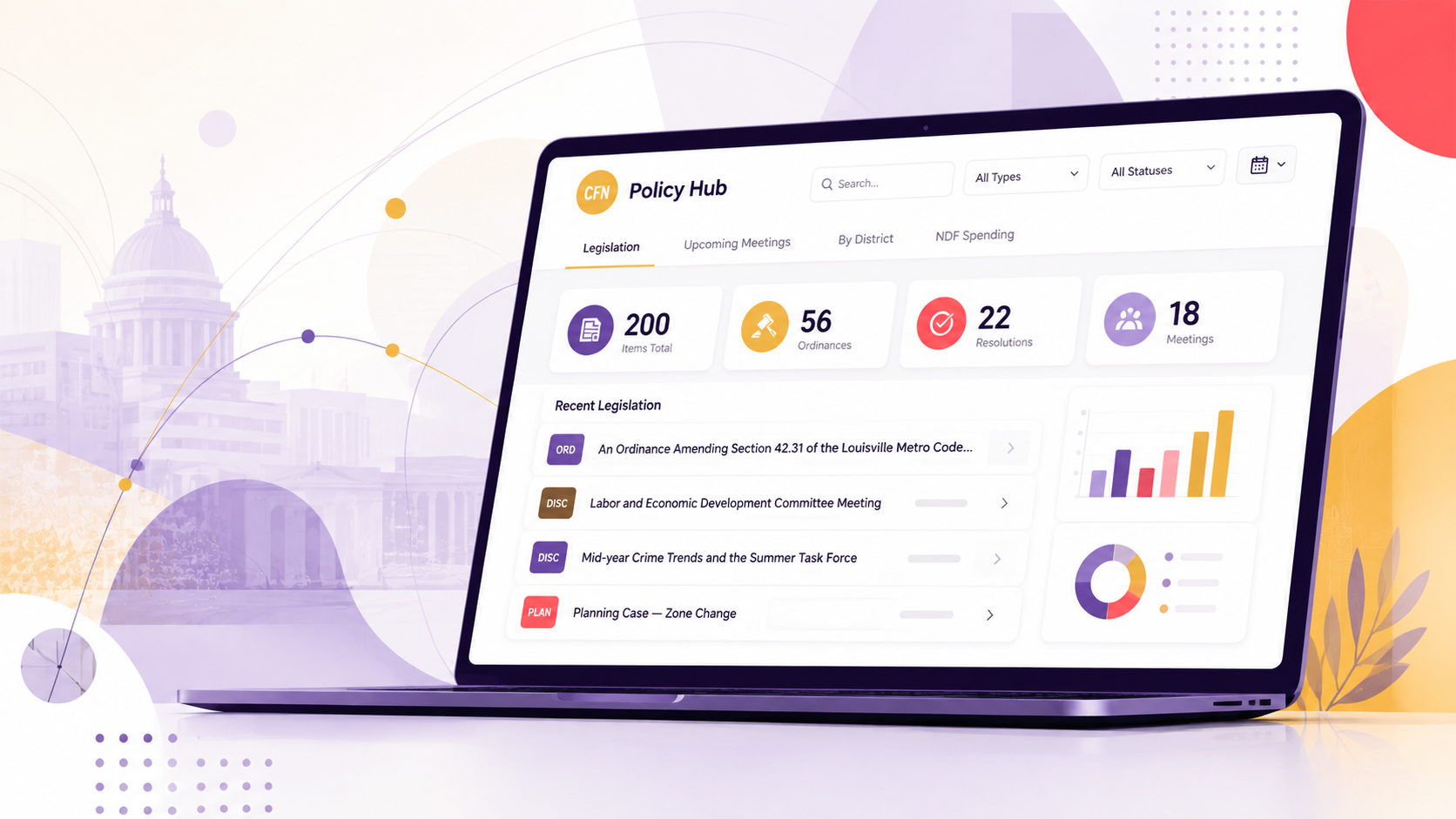
The CivicPulse Policy Hub is now live.
It pulls real-time data from Louisville’s Legistar system, the same database used by Council staff, and displays recent legislation and upcoming meetings in plain language. That means residents can begin to see what is moving through Metro Council without having to decode the system from scratch.
We have also begun tracking the Metro budget in depth: where revenue comes from, how dollars are allocated across departments, and what Neighborhood Development Fund dollars actually reach West and South Louisville.
This is still early work, but the point is already clear. Public data can be more than a record of what happened after the fact. It can be a tool residents use to understand what is happening now.
That is what CivicPulse is building toward: a civic information resource that helps Louisville residents follow the money, understand the decisions, and see the patterns that are too often hidden in plain sight.
Why This Matters Now
The neighborhoods that have been left behind did not end up that way by chance.
Budget decisions, zoning choices, infrastructure priorities, capital projects, department allocations, and neighborhood funding decisions are made year after year. Over time, those decisions shape which communities receive investment, which places are ignored, and which residents have to fight the hardest for the basics.
West Louisville has experienced generations of underinvestment. South Louisville’s immigrant communities are navigating systems that were rarely designed with them in mind. Across the city, the people most affected by public decisions are often the last to know those decisions are happening.
CivicPulse exists to close that gap.
The goal is not to turn every resident into a policy expert. The goal is to make the process clear enough that people can ask sharper questions, show up earlier, organize more effectively, and hold decision-makers accountable.
Because civic access is not a luxury. It is a condition for neighborhood power.
Built by CFN. Designed to Grow.
CivicPulse is a program of Center for Neighborhoods, the Louisville organization that has been training neighborhood leaders, supporting community planning, and building civic capacity since 1972.
That history matters. CFN’s work begins with a simple belief: neighborhoods already have power. The role of an organization like CFN is to help neighbors use that power with clarity, confidence, and practical support.
CivicPulse is one way to do that in today’s information environment.
The project was inspired in part by CivicLex, the civic journalism and data organization in Lexington that has become a model for how a mid-sized city can give residents meaningful access to local government information. Louisville deserves that kind of civic infrastructure too.
We hope CivicPulse can grow into its own independent organization: a dedicated civic information resource for Louisville, built on rigorous data, resident relationships, and a deep commitment to the communities that need it most.
We are starting inside CFN because that is where the trust, track record, and neighborhood relationships already live.
This Only Works If It Is Funded
Civic information infrastructure should not depend on which neighborhoods can afford it.
CivicPulse is free, public, and built to serve residents in communities that have been systematically excluded from government processes. That means it cannot rely on subscriptions, paywalls, or insider access.
We are building toward a sustainable model that includes foundation support, municipal partnerships, and eventually an independent organization. Right now, the work is supported by Center for Neighborhoods and the funders who believe civic access is a prerequisite for equity.
Louisville’s public decisions belong to the public.
CivicPulse is here to make sure more residents can see them, understand them, and act on them.
Your Money. Your Council. Your City.
share this
Be Part of
the Story
The stories you’re reading are powered by residents building stronger communities. Donate today and support our residents, plans, and partnerships that make community-led change possible.