news & Insights

May 28, 2026

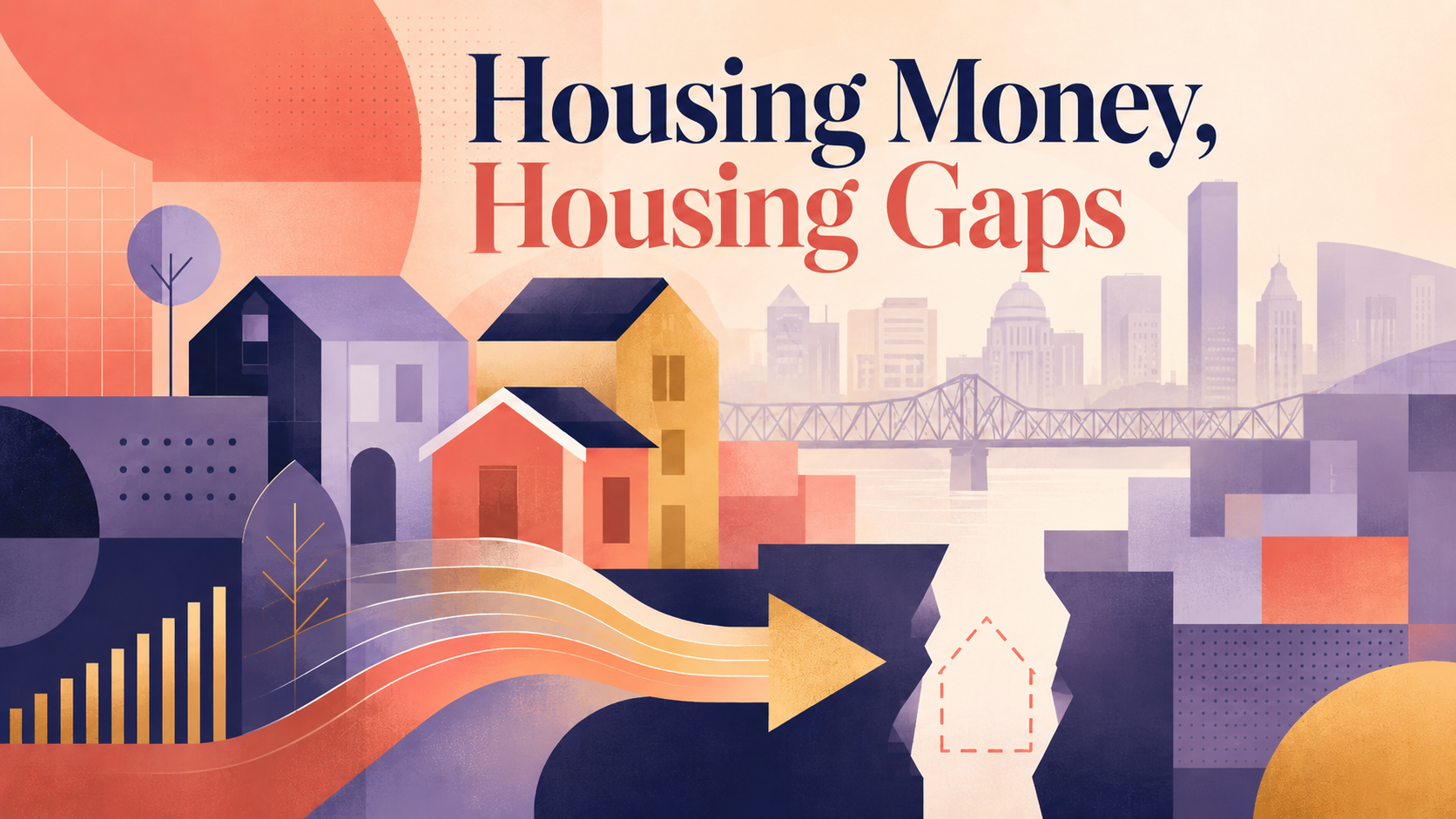
Louisville Is Investing in Housing. Is It Enough?
Center For Neighborhoods

Louisville’s proposed budget includes a real local commitment to housing: $23.1 million in city-controlled dollars.


That matters.


These are not federal pass-through funds with narrow rules and restrictions. These are the dollars Louisville controls directly.


They reflect local priorities, local choices, and local political will. But they also raise the bigger question: does $23.1 million match the scale of Louisville’s housing crisis?


What the City Is Actually Putting In


The proposed local housing investment has two major pieces:


$8.1 million for the Housing Office
This funds the engine that runs Louisville’s housing programs, including 54 full-time staff, contracts with partners like Habitat for Humanity and New Directions Housing, and positions focused on down payment assistance, eviction prevention, and housing stability. That office also helps deploy much larger federal funds. Without the staff and systems to manage housing programs, even outside money cannot move effectively.


$15 million for the Affordable Housing Trust Fund
This is Louisville’s primary local tool for creating affordable housing. The fund provides grants and loans to developers for rental and homeownership units. By ordinance, at least half of the fund must serve households below 50% of Area Median Income.

Last year, Metro Council reduced this amount from $15 million to $12.5 million. That $2.5 million cut translated into roughly 20 fewer housing units.


This year, the Mayor is proposing to restore the full $15 million.


That is good news.


It is also not the whole story.


What Local Dollars Are Producing


Louisville’s housing investments are producing visible results.


  • The Land Bank has seen an 84% increase in properties sold, moving from roughly 50 to more than 100. One developer reportedly built a house in 45 days from a Land Bank lot.


  • The Small Developer Loan Program is putting $2 million toward approximately 40 to 43 housing units, with 18 already completed.


  • Down Payment Assistance received 410 applications in just 60 days and is processing around 100 of them.


  • The Lien Waiver Program is helping move affordable rehab projects forward by forgiving code liens without spending new city dollars.


  • Home repair funding through Habitat for Humanity and New Directions is reaching approximately 250 homes per year.


These are not abstract budget lines. They are tools that help stabilize blocks, repair homes, create units, and help families stay rooted.


Where the Gaps Remain


The challenge is not whether Louisville is doing anything. It is.


  • The challenge is that the need is much larger than the current investment.


  • Home repair is one of the clearest examples. Louisville is investing roughly $1 million in home repair while the estimated need touches 29,000 homes.


  • Eviction prevention funding is down from the emergency levels available during COVID, even as housing instability remains a serious pressure for families.


Down payment assistance is oversubscribed, meaning the demand is already larger than the available funding.


And while the Mayor has talked about bringing new life to retail corridors, there is still no dedicated city housing or neighborhood investment program that fully meets that promise. The $1 million Big Streets Fund is bond-funded through Public Works, and the larger $47 million Section 108 loan has remained pending with HUD for two years.


The estimated total housing shortfall is more than $2 billion.


Against that need, the city’s local commitment is $23.1 million.


The Real Question Before Council


This budget should not be dismissed. It contains meaningful housing investments. It restores the Affordable Housing Trust Fund to $15 million. It supports the staff and partners needed to move housing programs. It funds tools that are already producing results.


But Louisville residents should be clear-eyed about the scale.


A $23.1 million local investment is important. It is also small compared to a crisis measured in billions.


So the question before Metro Council is not simply whether this budget includes housing money. It does. The real question is whether Louisville is prepared to build a housing strategy at the scale of the need.


Council votes on the final budget on June 25.


Residents can submit budget comments [here].


About CivicPulse

CivicPulse is a project of Center for Neighborhoods designed to help Louisville residents better understand the public decisions that shape their neighborhoods. Through plain-language summaries, budget breakdowns, and civic tools, CivicPulse helps residents follow what local government is doing, why it matters, and where there are opportunities to speak up.

This post is part of the Our Money, Our Neighborhoods series, which tracks how public dollars are being proposed, debated, and spent across Louisville.

share this

By Center For Neighborhoods • September 30, 2026
Start with Neighbors, then Follow their lead  Yesterday, Mayor Craig Greenberg stood in Russell and announced 25 new permanently affordable homes on Elliott Avenue. In that presentation, there was one thing not apparent: Russell: A Place of Promise, the neighborhood's community land trust, is leading the project. Its partners include The Housing Partnership, Inc., Louisville Metro Government, which is investing $1.45 million, and the Louisville Affordable Housing Trust Fund, which is adding $1 million. The homes are the part people will see. The part that made them possible started years ago, on front porches, when organizers knocked on doors and asked Russell residents what they wanted for their neighborhood. Then they kept listening, and eventually they handed residents the keys to the process itself. The most important asset is already there Asset Based Community Development starts from a simple idea: the people who live in a neighborhood are its foundation. Residents know which blocks are changing, which elders everyone trusts, and what a new development will mean for the family next door. No consultant can bring that knowledge in from outside. Russell has plenty to build on. It was once a hub of Black-owned businesses that created jobs and a center of Black homeownership. It is also a neighborhood that lived through redlining and urban renewal, and through decades of plans made about Black residents instead of with them. A resident-first approach takes both parts of that history seriously. How Russell did it Two leaders have carried this work from the start. Cassandra Webb and Theresa Zawacki, RPOP's Interim Co-Executive Directors, have led the initiative since its beginning, bringing backgrounds in community organizing and urban planning. That pairing matters. Organizing and planning worked side by side from the first day, instead of planning going first and outreach coming later. Webb has explained that the team chose from the beginning to invest in people first, because community development too often treats people as an afterthought. Zawacki has described the work as building shared decision-making and shared learning with Russell residents. The early work was slow and personal. Since 2018, RPOP has canvassed the neighborhood, held events large and small, and set up neighborhood pop-ups with resources. Those conversations grew into organized groups of residents. In 2020, the Russell for Russell Resident Coalition brought together 26 Black Russell residents between the ages of 22 and 72, and their work produced the Russell Partnership Pledge, a set of shared values that still guides RPOP. Residents didn't only give feedback on someone else's plan. RPOP's structure as a nonprofit community land trust, and its founding board members, came out of a multi-year shared learning process in which Russell residents worked with RPOP to define the organization's future. Today RPOP's board is made up mostly of community members who take part directly in land use planning. A community land trust works like this: residents buy the house while the land stays in trust, which lowers the cost of owning a home and caps resale prices so the home stays affordable for the next family. Residents picked this tool because it answers the question they kept raising. How do we welcome investment without being pushed out by it? What a resident-first process asks of us Russell's path breaks down into four steps. Each one builds on the one before it, and none of them can be skipped. Step 1: Go find people where they are. A meeting notice on a website reaches the people who already come to meetings. Knocking on doors reaches everyone else. In Russell, this meant years of canvassing, pop-ups, and events before anyone talked about a plan. Step 2: Let residents set the priorities. Once people are at the table, ask what matters most to them, and accept the answer even when it differs from what the city or a funder expected. A plan built on residents' priorities is stronger because neighbors will defend it. Step 3: Hand over the lead. Input sessions ask residents what they think. A resident-led process asks residents to decide, then gives them seats on the board that carries out the decision. In Russell, that board is made up mostly of community members. Step 4: Plan for years, and budget for them. RPOP launched in 2018. The homes announced today are breaking ground in 2026. That time was work, not a delay, and funders and the city have to pay for it the same way they pay for construction. Metro already knows how to do this For city leaders, the best news in Russell's story is that Metro helped start it. RPOP launched in 2018 with incubation from Cities United and Louisville Metro Government, and fiscal sponsorship from the Community Foundation of Louisville. Fiscal sponsorship means an established nonprofit handles the money and paperwork so a new effort can get started before it has its own nonprofit status. Metro also lent its own people. Zawacki left her position as Senior Policy Advisor to Louisville Forward to serve as an Executive on Loan to the initiative during its early years. And Metro has committed land: the former American Cigar Company site at 30th and Madison is owned by Louisville Metro Government with a formal commitment to RPOP, and residents plan to make it a mixed commercial and residential campus. Staff time, patient support, public land, and trust in residents' decisions made today's announcement possible. None of those are unusual tools. Metro can offer them to other neighborhoods on purpose. The ask Before Metro funds the next neighborhood plan in Louisville, build the RPOP steps into the contract from the start. Pay for door knocking and years of organizing, not only the final document. Require that residents set the priorities and hold seats on whatever body carries the plan forward. And when public land is on the table, offer it first to the residents who wrote the plan. Russell's neighbors did the hard work of deciding what their neighborhood needs. Twenty-five families on Elliott Avenue will soon live in the result.
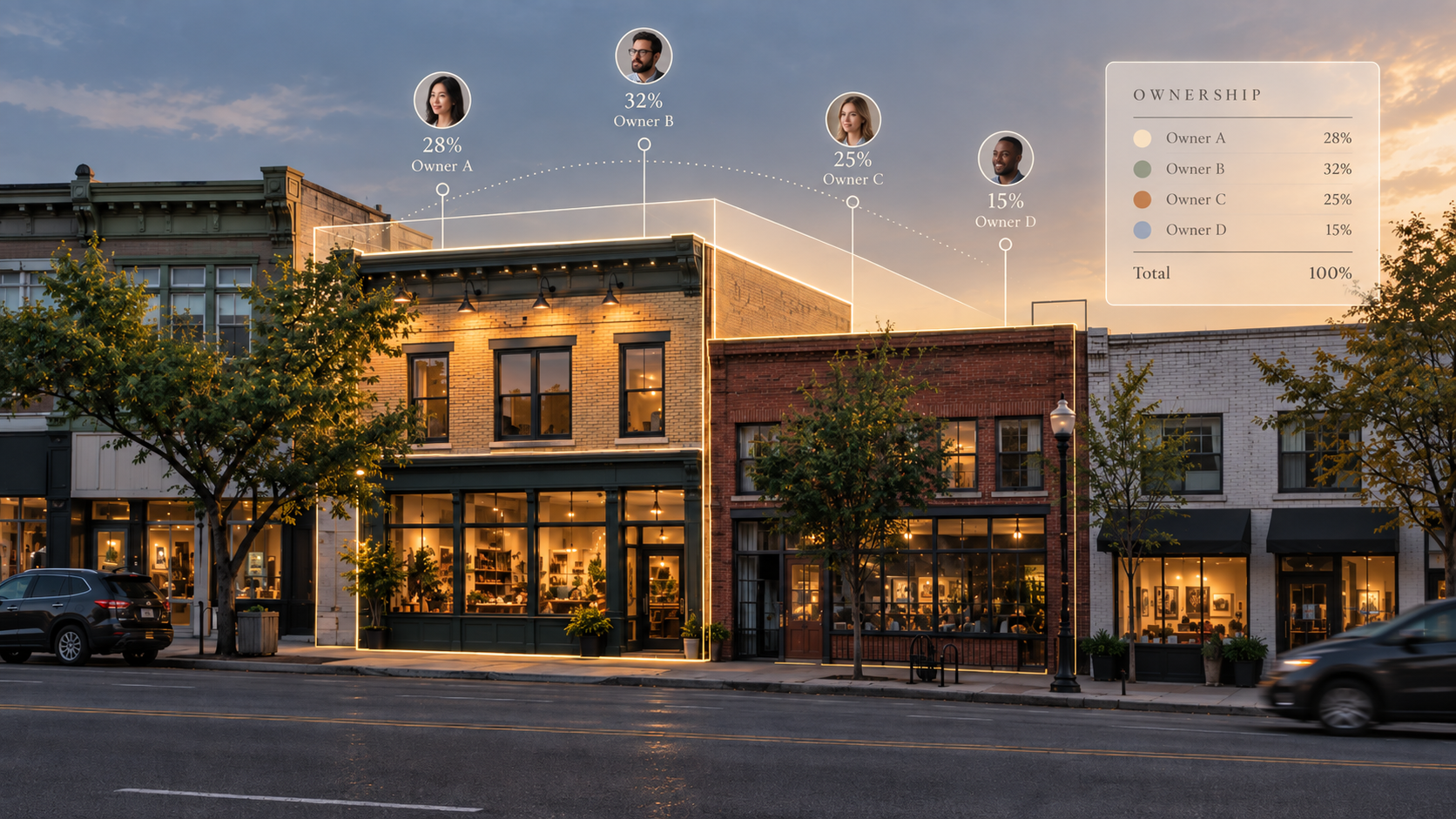
Modern storefronts at dusk with lit windows, trees, parked cars, and floating profile icons over the street.
By Center For Neighborhoods • September 28, 2026
How much of the commercial property in a neighborhood is owned by the people who live around it, and how much wealth has that ownership built for them? No one can answer. There is no registry, no reporting standard and no annual number. Capital allocates to what it can see, and this category is nearly invisible.
By Center For Neighborhoods • September 24, 2026
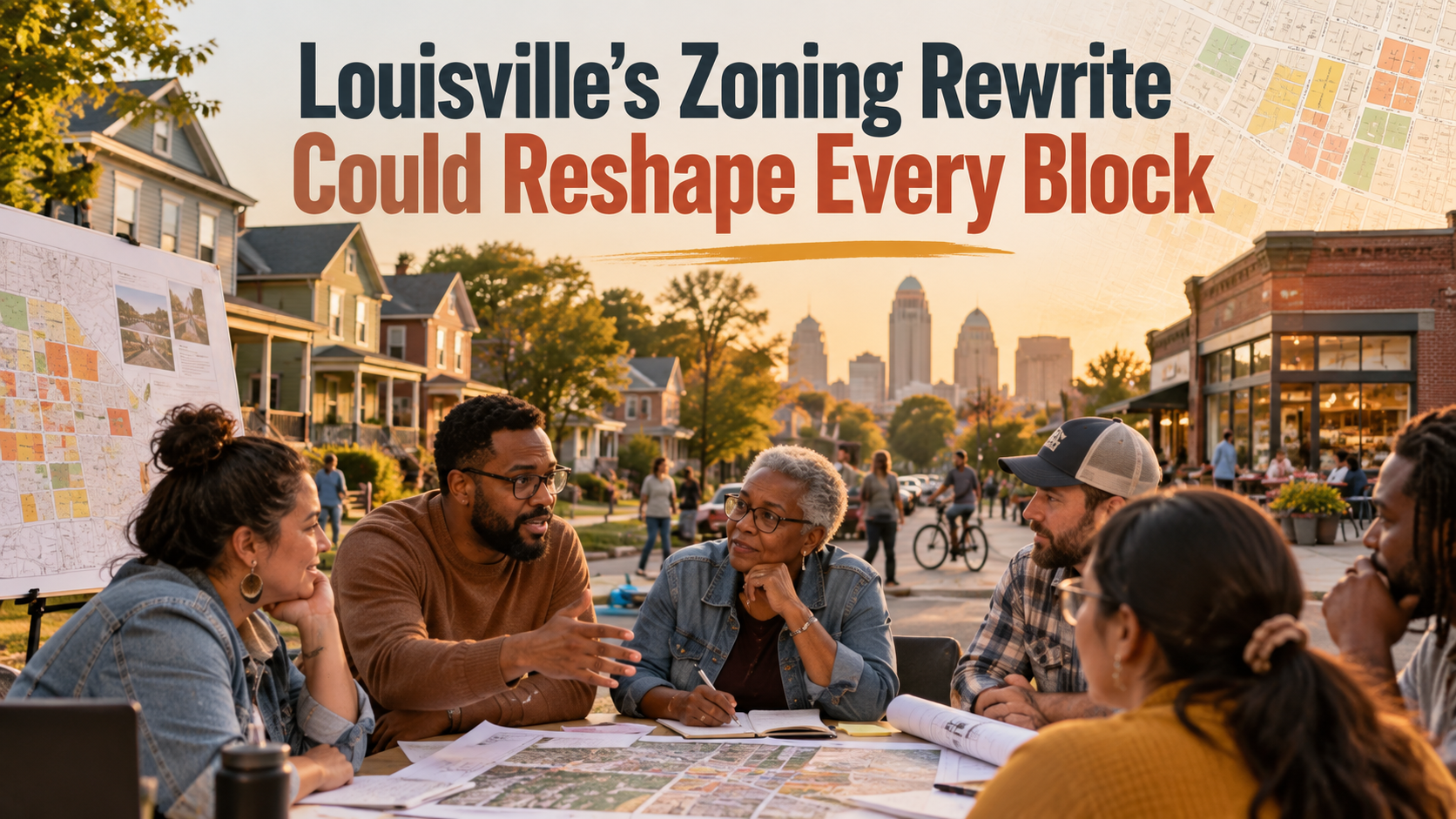
If you followed this year's fight over data centers in Jefferson County, you've already seen the Land Development Code at work. The packed public hearings, proposed setbacks from homes and schools, and Planning Commission's 5-3 vote in September all came down to rules about what gets built where. The same code that determines how close a 500,000-square-foot server farm can sit to a house also decides whether your street can have a duplex, a corner store, or a sidewalk that leads somewhere. Louisville is now rewriting that code in full for the first time since 2003. The Land Development Code puts the city's comprehensive plan, Plan 2040, into practice. It defines single-family and duplex lots, determines which businesses can open on commercial corridors, and sets rules for subdivision plats, signs, landscaping, and connections to transit. It applies to every neighborhood in Jefferson County outside the 12 independent cities. In 2020, Metro Council passed Resolution 82, directing the Office of Planning to recommend changes that would make development more equitable and inclusive. A HUD grant is funding the full rewrite. The goals are to bring the code up to date, make it easier for residents and applicants to navigate, and use language people can understand without a lawyer. In West and South Louisville, decades of disinvestment have left neighborhoods with walkable streets and small lots that could support duplexes and corner apartment buildings. But the code still limits most of those blocks to single-family homes. Neighbors can't legally rebuild the density that once existed there. The Highlands has nearly identical old streets and mostly allows that housing mix today, which helps explain why it looks the way it does. Farther out, in wealthier, less dense parts of the county, large-lot, single-family-only zoning continues to keep density and diverse neighbors out, just as it was designed to do almost a century ago. An equitable rewrite needs to address those restrictions along with the barriers in West and South Louisville. Neighborhoods that used zoning to stay closed off should be part of the change. For families, the rewrite could change the housing choices available on their block. Across much of the city, single-family-only zoning rules out duplexes, accessory units, and small apartment buildings that help keep neighborhoods affordable for multiple generations of the same family. Small businesses face their own barriers. Rigid commercial zoning can make it hard to open a corner store, restaurant, or home-based business on a street where neighbors already walk and want those services. The new rules will help determine what housing and businesses are possible in your neighborhood for years. CFN's Policy Hub explains how zoning works, what form districts are, and how a text amendment such as the data center rules moves through Metro Council. Its plain-language zoning and planning overview is one of the site's most-visited pages. The update runs through December 2028. Plans call for 12 public meetings in three rounds, with planning staff office hours after each round. There will also be six focus groups, including one for neighborhood organizations, and neighborhood walking tours. Before the first round of meetings, the Office of Planning is holding Community Dinner Conversations for neighborhoods that have historically been left out of planning discussions, including West and South Louisville. No meeting dates are posted yet. Sign up for project updates on Louisville Metro’s LDC Project website to be notified when public meetings and other engagement opportunities are announced. CivicPulse is presented by Center for Neighborhoods as part of our effort to use AI to help distill public information and make civic issues easier to follow. AI can make errors. Please let us know how we’re doing.

Be Part of

the Story

The stories you’re reading are powered by residents building stronger communities. Donate today and support our residents, plans, and partnerships that make community-led change possible.

Make a Donation