news & Insights
Case Study: Education That Turns Neighbors into Civic Operators
Most neighborhoods don’t lack passion. They lack leverage—the know-how to navigate systems, build consensus, and move from frustration to action. CFN’s education work exists to close that gap: we teach people how power works, how neighborhoods organize, and how to turn ideas into outcomes.
The situation
When government agencies, utilities, and major institutions come into a neighborhood, the “default” outcome is predictable: residents are asked to react to decisions already in motion. CFN’s experience—shared by leaders who’ve worked across Louisville’s public systems—is that neighborhoods with trained leadership perform differently. They can define priorities, articulate consensus, and negotiate for real results instead of being managed or divided.
The CFN education intervention
CFN’s education model is built around a simple belief: knowledge is power only when people can apply it together.
As one CFN executive director wrote, community design is ultimately about empowering residents to “shape their own preferred futures” by acquiring and applying information in a more systematic, democratic way.
That philosophy shows up in our flagship leadership education pipeline—especially the Neighborhood Institute—where participants build practical skills and relationships that carry beyond the classroom.
What “Education” looks like in practice
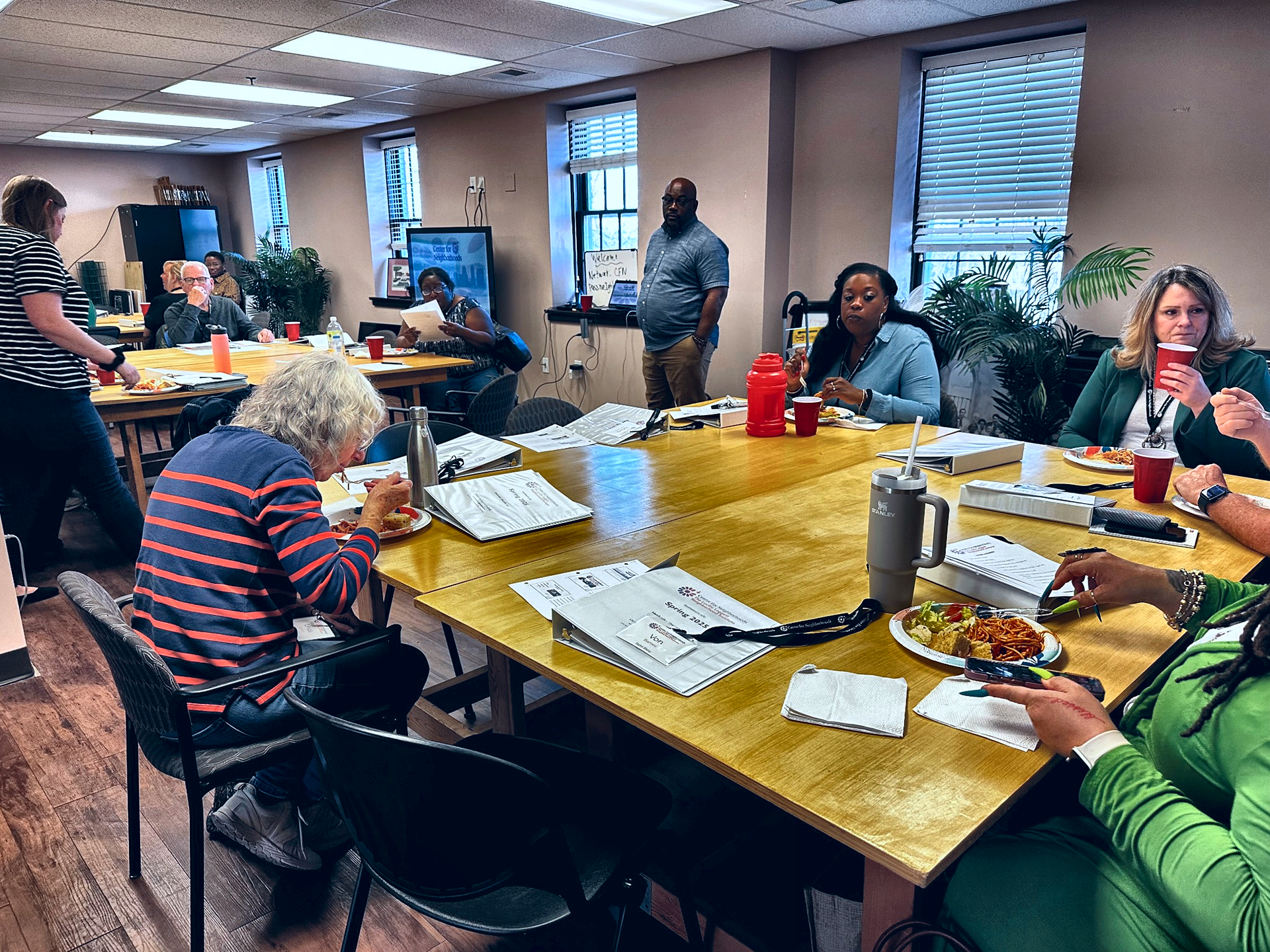
In the Neighborhood Institute, neighbors from across Louisville come together for structured learning that covers the fundamentals that actually move neighborhoods:
- Community organizing
- Effective leadership strategies
- Relationship-building across districts and differences
The program is intentionally designed to create “stickiness”—people don’t just come for content; they stay for the network. In one recent kickoff, CFN noted participants from 12 districts, describing an environment where neighbors are actively building ideas together (and yes, sharing meals—because trust is built in the human moments, not just the agenda).
Outcomes that matter to the real world
Education isn’t the end goal. It’s the force multiplier.
A former CFN board member and long-time public agency leader described a consistent pattern: when neighborhoods had associations and leaders—often including Neighborhood Institute graduates—they were “almost always better” at expressing neighborhood consensus and supporting action plans. In other words: trained neighborhood leadership makes large systems more accountable and more effective.
People who first engage through CFN frequently go on to become elected officials, board members, and civic leaders—the kind of long-term leadership pipeline Louisville needs if we want neighborhood change that lasts.
Representative Joshua Watkins—now a Kentucky House Representative for District 42 and a current CFN Board Director, first encountered CFN through the Neighborhood Institute while working in city government on land banking efforts. As he puts it: 0
“It was always a vehicle for change for everyday people… a place that connected resources and people who probably otherwise wouldn’t… work on a project together that was centered in your neighborhood.”
That’s the point of the education pipeline: it doesn’t just inform people—it builds the capability and relationships that let residents lead projects, shape policy, and ultimately step into formal leadership roles.
Why this is the “first step” in community transformation
CFN’s broader model works because education comes first. Without education:
- engagement turns into one-way “input”
- planning becomes technical, not community-owned
- investment flows without accountability
With education, neighborhoods build the internal capacity to lead—again and again—across issues, administrations, and market cycles.
That’s the point: we’re not just delivering workshops; we’re building civic operators who can run plays in the real world.
share this

Be Part of
the Story
The stories you’re reading are powered by residents building stronger communities. Donate today and support our residents, plans, and partnerships that make community-led change possible.