
Weekly Blog
CFN Updates
St. James Court, Then and Now: The Story That Shaped CFN
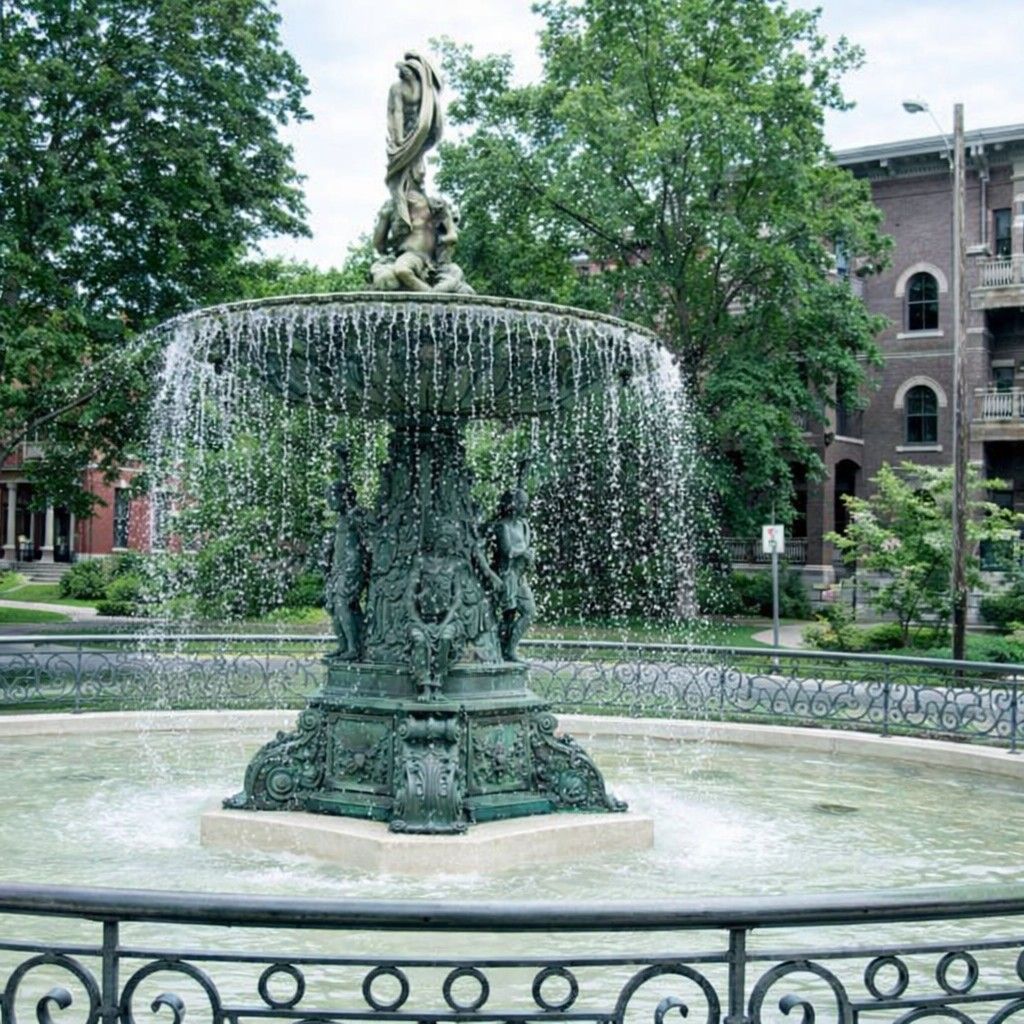
On a quiet evening in Old Louisville, St. James Court doesn’t feel like a “district.” It feels like a living room for an entire city—gas lamps glowing, the fountain humming, giant porches leaning toward the sidewalk like they want to start a conversation. It’s one of Louisville’s original “walking court” showpieces, and it’s been recognized for that history for decades. (NPGallery)
But here’s the part people forget: this beauty wasn’t inevitable. In the late 20th century—especially by the time the 1980s rolled around—Old Louisville was still working its way back from a long slide that started earlier in the century, when oversized homes became hard to maintain and many were chopped into apartments. (Curbed)
And St. James Court—iconic as it is—was not immune to the basic question that haunts every historic neighborhood: How do you keep the buildings alive when the market can’t carry them?
The moment that created our “why”
Center for Neighborhoods began in 1972 as the Louisville Community Design Center—part of a national wave of community design centers created to help residents overcome barriers like redlining and the damage of urban renewal. The idea was simple and radical: communities deserved professional-grade design help and practical plans, not just opinions from the outside. (GovDelivery)
That origin matters for St. James Court because the neighborhood’s challenge wasn’t abstract. These were big, aging structures with high operating costs. When a mansion can’t find a buyer, it doesn’t “pause.” It deteriorates. And deterioration, in a historic place, becomes a countdown.
So CFN and neighborhood partners did what Louisville needed at that time: they focused on viability. People who were there describe early work that included evaluating a set of large homes and helping chart a path to convert them from single-family houses into multi-family dwellings—an adaptive-reuse move that kept roofs repaired, utilities stable, and the neighborhood occupied.
That kind of work—pragmatic, architectural, survival-focused—helped preserve the physical bones of Old Louisville at a moment when many cities lost theirs forever.
What worked—and why it worked
If you want a clean, visible “proof of concept,” look at what St. James Court still is: a place where architecture, public space, and walkability create real value. The National Register documentation highlights that the courts became a kind of intentional enclave—an early form of urban planning that produced an unusually cohesive pedestrian environment.
And the neighborhood has always attracted creative energy. The National Register materials even note how the courts tended to draw “creative personalities in the arts,” the kind of people who bring vibrancy before the market brings money.
Then the St. James Court Art Show became part of the neighborhood’s self-rescue story—an event launched in the 1950s that grew into a cultural anchor and economic engine. (Spectrum News 1)
For decades, one weekend a year has reminded Louisville what this place is worth.
This is the win: the buildings survived long enough for the neighborhood to become desirable again. The uncomfortable truth: saving buildings isn’t the same as building a complete neighborhood.
Now for the hard part—the part we can’t romanticize.
Even with all the success, Old Louisville has wrestled for years with day-to-day quality-of-life needs that a thriving neighborhood should have solved. One glaring example: groceries.
In 2019, a major report on Louisville’s closing grocery stores pointed out that a former Kroger at 922 S. Second Street in Old Louisville was purchased for a non-grocery use—and the story quoted local leadership saying plainly that the neighborhood still needed grocery options and that the lack of fresh, affordable food choices was “disheartening.” (USC Center for Health Journalism)
That line lands because it exposes the gap between historic preservation and neighborhood health. A community can have extraordinary architecture and still struggle with basic access.
And that’s the bigger lesson from St. James Court: you can protect the shell and still miss the system.
The neighborhood is changing again—this time in reverse
There’s another twist that would have sounded impossible decades ago: some of those multi-family conversions are now being undone.
A high-profile example sits right on St. James Court—“The Pink Palace.” It’s known today as a single-family home, and the story notes that it was converted and later returned to single-family use. (StyleBlueprint)
This trend isn’t just one quirky house. City planning language in recent years has even referenced conversions back to single-family use as a “current market trend” in the Old Louisville/Limerick area. (Louisville.gov)
Is that success?
Yes—and also, it depends what kind of success you mean.
- If the goal was preservation and long-term demand, the “reverse conversion” is a signal the neighborhood won.
- If the goal was durable mixed-income housing and room for “the wanderers,” the reverse conversion raises a warning flag about affordability, displacement pressure, and who gets to stay once a place becomes valuable.
What we would do differently today—and why our work has evolved
This is where CFN’s origin story becomes more than history—it becomes a compass.
CFN has evolved from a design center doing primarily human-centered architecture work into an organization focused on education, engagement, and resident leadership—training and programs that help neighbors define priorities and build power together.
That shift isn’t “mission drift.” It’s maturity.
Because St. James Court taught Louisville something that community developers have had to learn the hard way: Physical change without people-power is fragile. It can preserve buildings, but it won’t necessarily produce belonging, stability, or equitable outcomes.
If CFN were doing that same St. James-style work today, the blueprint would be bigger than floorplans:
- We’d still fight for the buildings—because place matters.
- But we’d also organize around the systems that decide whether a neighborhood functions: food access, small business vitality, renter protections, wealth-building pathways, civic trust, and resident-led decision-making.
- And we’d measure success not just by rehabbed facades—but by whether residents can actually build a life there.
Conclusion: the new model is people who can move a city
St. James Court is proof that neighborhoods can come back. It’s also proof that “coming back” doesn’t automatically mean “getting better for everyone.”
CFN’s work today is a new model because it refuses to choose between the two. We help residents build the skills, relationships, and shared plans that turn hope into action—so change isn’t something that happens to a neighborhood, but something neighbors produce together.
We’re not just helping improve blocks; we’re helping people rebuild agency in their own lives, and then scale that agency into collective power.
That’s the real legacy of St. James Court: when people have tools, voice, and a way to act together, they can save what matters—and build what’s been missing.
share this

Be Part of
the Story
The stories you’re reading are powered by residents building stronger communities. Donate today and support our residents, plans, and partnerships that make community-led change possible.
