
news & Insights
Louisville Is Rewriting the Rules for What Gets Built Where
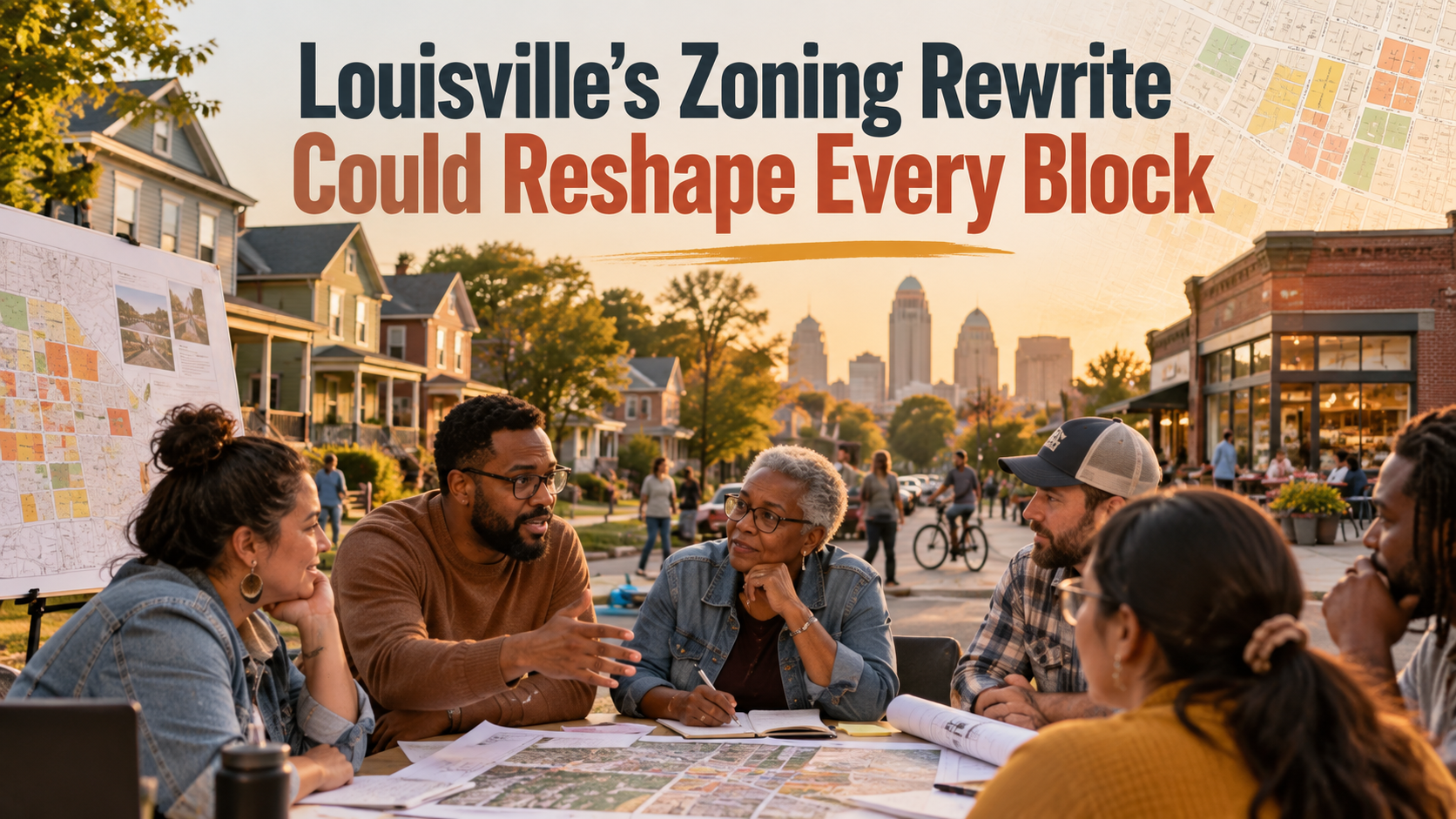
If you followed this year's fight over data centers in Jefferson County, you've already seen the Land Development Code at work.
The packed public hearings, proposed setbacks from homes and schools, and Planning Commission's 5-3 vote in September all came down to rules about what gets built where. The same code that determines how close a 500,000-square-foot server farm can sit to a house also decides whether your street can have a duplex, a corner store, or a sidewalk that leads somewhere. Louisville is now rewriting that code in full for the first time since 2003.
The Land Development Code puts the city's comprehensive plan, Plan 2040, into practice. It defines single-family and duplex lots, determines which businesses can open on commercial corridors, and sets rules for subdivision plats, signs, landscaping, and connections to transit. It applies to every neighborhood in Jefferson County outside the 12 independent cities.
In 2020, Metro Council passed Resolution 82, directing the Office of Planning to recommend changes that would make development more equitable and inclusive. A HUD grant is funding the full rewrite. The goals are to bring the code up to date, make it easier for residents and applicants to navigate, and use language people can understand without a lawyer.
In West and South Louisville, decades of disinvestment have left neighborhoods with walkable streets and small lots that could support duplexes and corner apartment buildings. But the code still limits most of those blocks to single-family homes. Neighbors can't legally rebuild the density that once existed there. The Highlands has nearly identical old streets and mostly allows that housing mix today, which helps explain why it looks the way it does.
Farther out, in wealthier, less dense parts of the county, large-lot, single-family-only zoning continues to keep density and diverse neighbors out, just as it was designed to do almost a century ago. An equitable rewrite needs to address those restrictions along with the barriers in West and South Louisville. Neighborhoods that used zoning to stay closed off should be part of the change.
For families, the rewrite could change the housing choices available on their block. Across much of the city, single-family-only zoning rules out duplexes, accessory units, and small apartment buildings that help keep neighborhoods affordable for multiple generations of the same family.
Small businesses face their own barriers. Rigid commercial zoning can make it hard to open a corner store, restaurant, or home-based business on a street where neighbors already walk and want those services. The new rules will help determine what housing and businesses are possible in your neighborhood for years.
CFN's Policy Hub explains how zoning works, what form districts are, and how a text amendment such as the data center rules moves through Metro Council. Its plain-language zoning and planning overview is one of the site's most-visited pages.
The update runs through December 2028. Plans call for 12 public meetings in three rounds, with planning staff office hours after each round. There will also be six focus groups, including one for neighborhood organizations, and neighborhood walking tours. Before the first round of meetings, the Office of Planning is holding Community Dinner Conversations for neighborhoods that have historically been left out of planning discussions, including West and South Louisville.
No meeting dates are posted yet. Sign up for project updates on Louisville Metro’s LDC Project website to be notified when public meetings and other engagement opportunities are announced.
CivicPulse is presented by Center for Neighborhoods as part of our effort to use AI to help distill public information and make civic issues easier to follow. AI can make errors. Please let us know how we’re doing.
share this
Be Part of
the Story
The stories you’re reading are powered by residents building stronger communities. Donate today and support our residents, plans, and partnerships that make community-led change possible.