
news & Insights
City Hall Is Growing. Are Neighborhood Investments Keeping Up?
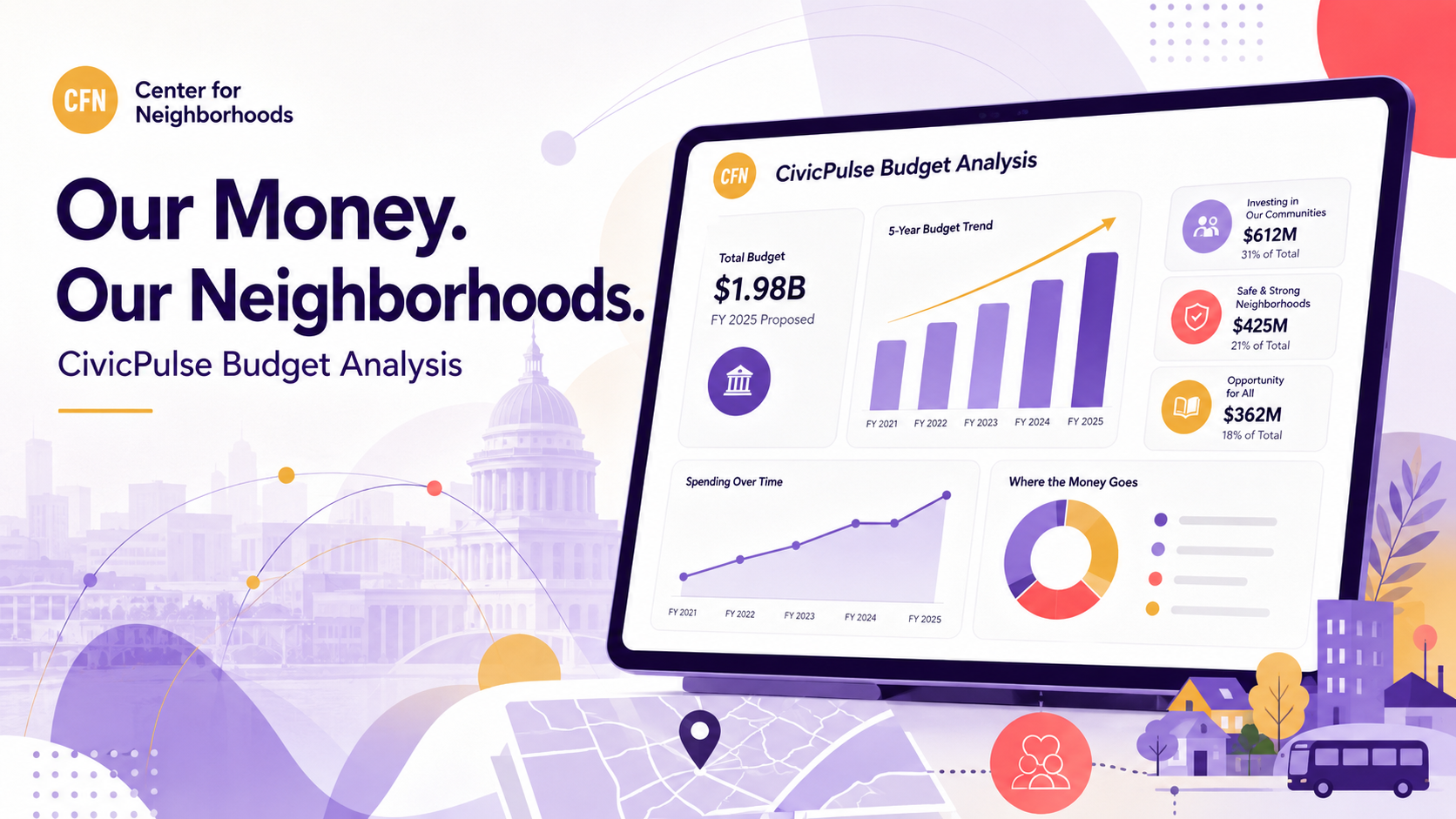
Follow the Money: What Louisville’s 5-Year Budget Trend Tells Us About City Priorities
Budgets are not just spreadsheets. They are choices.
They tell us what a city is protecting, what it is expanding, and what it is willing to let shrink. And when we look at Louisville Metro’s budget trends over the last five years, one thing becomes clear: some parts of local government have grown significantly, while other departments tied directly to neighborhoods, housing, and planning have lost ground.
That is why CivicPulse produces Our Money. Our Neighborhoods., a budget accountability effort from Center for Neighborhoods focused on helping residents follow Louisville Metro’s public dollars.
CivicPulse was created to make local government easier to understand. The Policy Hub tracks legislation, Metro Council meetings, committee activity, neighborhood funding, and the decisions moving through City Hall. Our Money. Our Neighborhoods. takes that same idea and applies it to the budget.
Because the budget is not just a spreadsheet. It is public money. It is neighborhood money. It is our money.
And residents deserve to understand where it goes.
Five Years. One Story.
Over the past five years, Louisville Metro’s overall budget grew by 28%. Some departments grew much faster than that. The Office of Violence Prevention increased by 114%. Youth Transitional Services grew by 106%. The Office of Social Services grew by 90%. Metro Technology Services grew by 67%. Parks and Recreation grew by 27%, and Louisville Metro Police grew by 25%.
Those increases may reflect real needs. Violence prevention, youth services, social supports, technology, parks, and public safety all matter. The point is not that growth is automatically bad.
The point is that growth reveals priorities.
And the other side of the trend is harder to ignore.
According to the latest CivicPulse review, departments most connected to long-term neighborhood investment in West and South Louisville lost ground. Housing and Community Development fell by 17%, dropping from roughly $10 million to $8.3 million. The Office of Planning fell by 47%, from $4.6 million to $2.4 million — nearly cut in half.
That is not a small technical adjustment. That is a signal.
Housing and planning are not abstract departments. They shape whether families can stay in their neighborhoods. They influence whether vacant land becomes opportunity or blight. They affect how growth happens, who benefits from it, and whether public investment reaches the places that have been waiting the longest.
At the same time, the Mayor’s Office grew by 129% — from $2.45 million under Mayor Fischer in FY22-23 to $5.51 million today, with $6.97 million proposed for FY26-27. By FY2027, the Mayor’s Office would be nearly as large as Metro Council’s entire budget.
That raises a fair and simple question:
Is this the right investment?
The answer does not belong only to City Hall. It belongs to residents.
Louisville’s budget is public money. Your money. Neighborhood money. The question is not just how much the city spends, but where that spending goes and what kind of future it builds.
A growing budget should mean growing capacity to solve the problems residents actually feel: housing instability, neighborhood disinvestment, unsafe streets, limited opportunity, weak infrastructure, and uneven access to services. If the overall budget is growing while neighborhood-centered departments are shrinking, residents deserve to know why.
Strong Finances, Real Risks
The analysis does not say Louisville is in crisis.
It says something more useful: Louisville is financially strong, but the city should be clear-eyed about the risks ahead.
The fund balance is healthy. Revenues have grown. The city has made real investments. But the budget also depends on several conditions that may not last.
Investment income has been boosted by high interest rates. Non-recurring revenue helped support this year’s total available funds. A proposed general obligation bond would create future debt service obligations. Several departments grew quickly, which makes it harder to evaluate what is working and creates a larger base to sustain when growth slows.
These are not reasons to panic.
They are reasons to plan.
Good stewardship means asking hard questions while the city still has room to make choices.
Because this is not just a budget.
This is a map of Louisville’s priorities.
And the people who live in Louisville should help decide where that map leads.
CivicPulse is presented by Center for Neighborhoods as part of our effort to use AI to help distill public information and make civic decisions easier to understand. AI can make errors. Please let us know how we’re doing.
share this



Be Part of
the Story
The stories you’re reading are powered by residents building stronger communities. Donate today and support our residents, plans, and partnerships that make community-led change possible.