
news & Insights
When the Rules Leave Neighborhoods Out
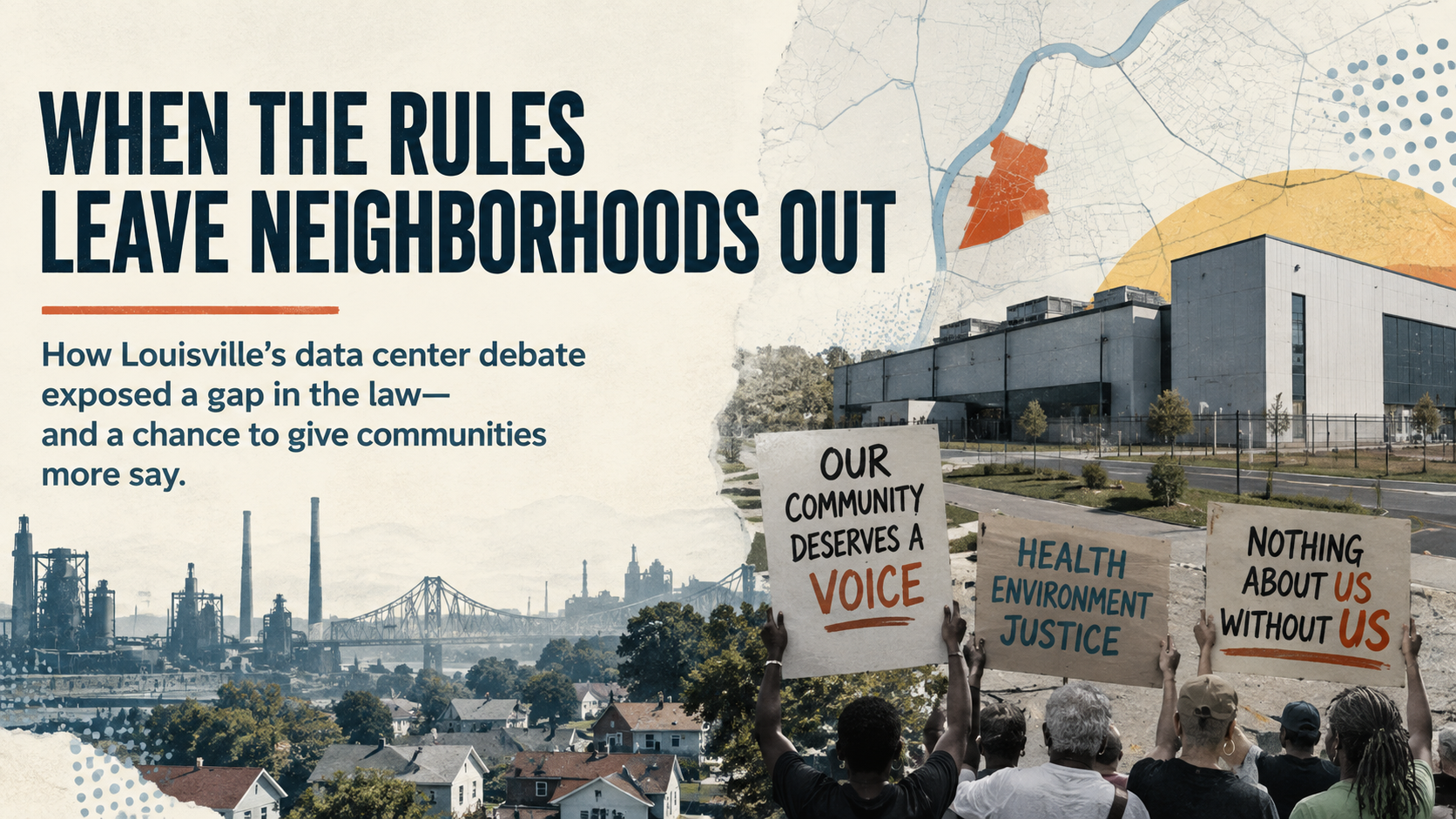
How Louisville’s data center debate exposed a gap in the law — and a chance to give communities more say.
In March, Louisville approved a massive new data center in West Louisville despite more than twenty residents showing up to raise concerns about energy use, noise, environmental impact, and what another industrial-scale project could mean for their neighborhoods. The problem was bigger than one Planning Commission vote: the rules gave commissioners almost no ability to consider those questions at all. Now Louisville is rewriting those rules, and what happens next could determine how much say neighborhoods have when the next data center comes calling.
West Louisville neighborhoods have carried more than their share of industrial burden for decades. Rubbertown. Portland. Cane Run. Riverport. These are the same communities that watched a 1.6-million-square-foot data center get approved in March 2026 — over the objections of more than twenty residents who showed up and testified against it.
The Commission voted 6-1 to approve.
Here's why that happened, and why it matters for what comes next.
The facility was classified as a "telecommunications hotel" under Louisville's Land Development Code — a category written before hyperscale data centers existed. The property was already zoned M-3 heavy industrial. No rezoning was required. And because no rezoning was required, the Planning Commission could ask exactly one question by statute: does this project comply with the current Land Development Code? Setbacks, building footprint, location on the parcel. That's the list.
Commissioner Fischer said it plainly at the hearing: "We're not voting on whether AI is going to continue. We aren't voting on some of the bigger issues you came up here with."
There were no criteria for environmental impact. No criteria for the 400-megawatt energy draw — roughly the monthly electricity consumption of 400,000 homes. No criteria for noise, water use, or what it means to add that kind of infrastructure load to communities already carrying Louisville's heaviest industrial burden. Twenty-plus residents spoke. The code offered them no leverage.
That's the policy gap Louisville is now trying to close.
The proposed data center regulations create a tiered framework based on facility size. Large facilities would require conditional use permits and public hearings. That changes the legal standard: instead of "does it comply with the code," the question becomes "does it meet conditions the community and regulators can negotiate?" Hyperscale facilities — over 500,000 square feet — would be prohibited outright in residential-adjacent zones. The proposal also adds 500-foot buffers from schools and homes, noise caps, utility impact studies, and a 30% local hiring requirement for construction.
These aren't automatic protections. They depend on the regulations being adopted, and on residents knowing the process well enough to use it when the next application comes in.
CFN analyzed the proposed framework in full so neighbors and neighborhood organizations have what they need to engage. Read it, share it, bring it to your next community meeting.
hub.centerforneighborhoods.org/datacenter-analysis.html
share this


Be Part of
the Story
The stories you’re reading are powered by residents building stronger communities. Donate today and support our residents, plans, and partnerships that make community-led change possible.