
news & Insights
Louisville’s Budget Is Growing. Now Comes the Real Question: How Will the Money Be Used?
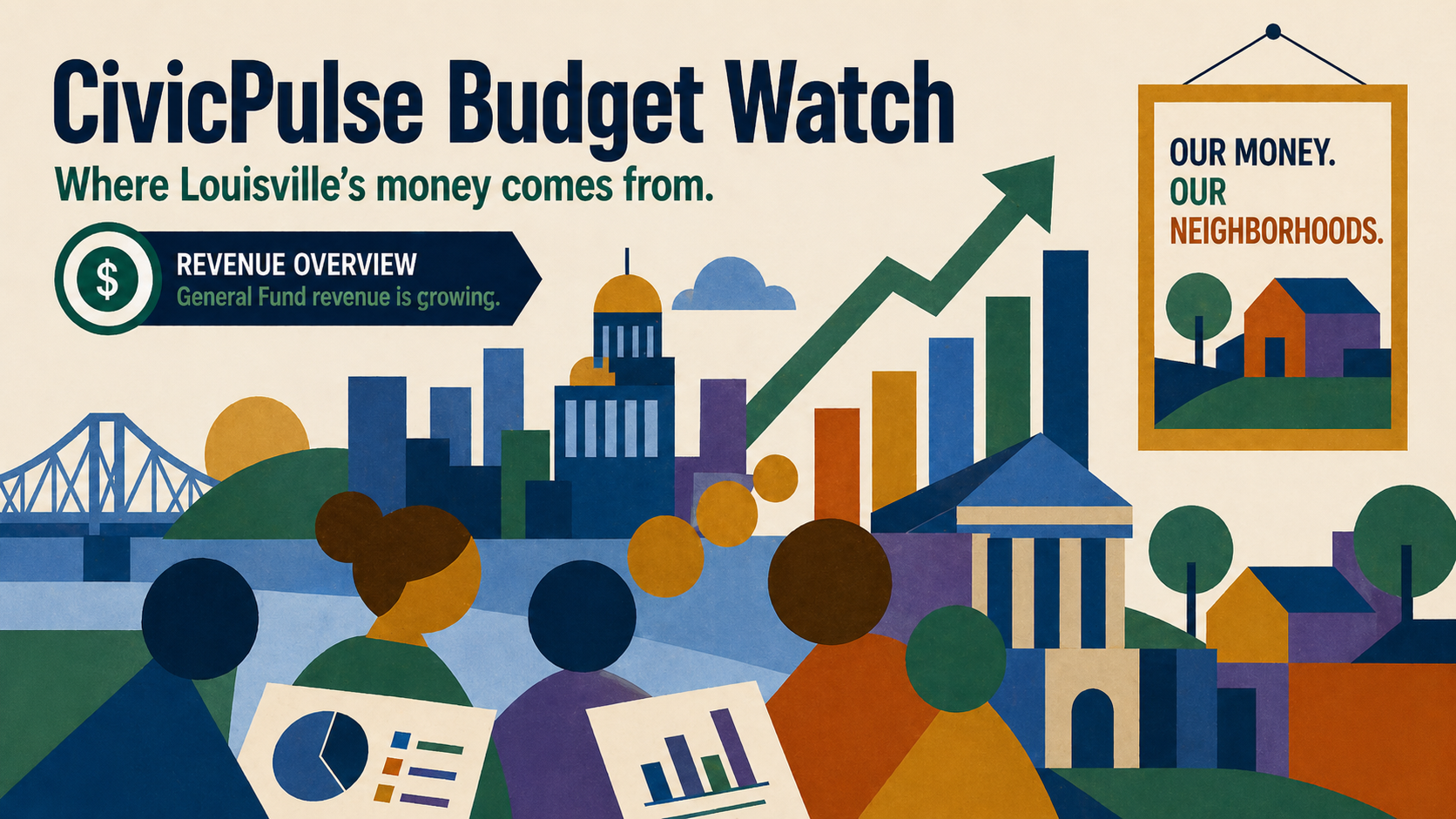
This week’s Our Money, Our Neighborhoods budget review starts with a simple but important fact: Louisville Metro is expecting more General Fund revenue this year — $919 million total, up $42.5 million from last year.
As Mayor Greenberg put it: “The city is collecting more money. No tax increase required.”
That matters. Because before residents can weigh in on what the budget should fund, we need to understand where the money is coming from.
The short answer: mostly from people working in Louisville, rising property values, and a few key public revenue sources.
The biggest source: your paycheck: The largest single source of Louisville Metro’s General Fund revenue is the wage tax.
This year, the city expects to collect $414.4 million from the 1.25% wage tax. That is 45% of all General Fund revenue and an increase of $16.6 million over last year.
In plain language: when more people are working in Louisville, or when wages grow, the city collects more money.
That makes the local economy directly connected to the city budget. Jobs, wages, and employment growth are not abstract economic indicators. They are a major part of how Louisville pays for public safety, libraries, parks, public works, housing, youth programs, and other basic services.
The second biggest source: your property: Property taxes are the second largest source of revenue.
This year, Louisville expects to collect $234.1 million from property taxes — about 25% of all General Fund revenue. That is up $10.5 million, or 4.7%, from last year.
This increase is not coming from a higher tax rate. It is largely coming from rising property values. In fact, the tax rates may actually drop slightly this year.
That distinction matters. Residents may still feel the impact of higher assessments, but the city’s revenue growth is being driven by the value of property increasing across Louisville, not by a new tax increase.
Business profits are down slightly
Not every revenue line is growing.
Revenue from business profits is expected to be $101.1 million, or about 11% of all General Fund revenue. That is down $2.4 million, or 2.3%, from last year. That makes business profits the only major revenue line in this week’s review that is moving downward.
This is a reminder that the city’s budget does not grow evenly across every category. Some sources rise, some flatten, and some decline. Understanding that mix helps residents see what is stable, what is growing, and what may need closer attention.
Insurance premiums and investment income are also part of the picture
The city also expects $97.7 million from insurance premium taxes, which are generated by a 5% tax on premiums written in Louisville.
Investment income is the surprise. Last year, Louisville received $8.1 million in investment income. This year, that number is expected to be $17.1 million — more than double. That is a meaningful increase. It suggests the city is benefiting from stronger returns on the money it holds and manages.
And then there is the Louisville Water Company dividend
Louisville Metro also expects to receive a $37 million dividend from Louisville Water Company, which is wholly owned by Louisville Metro. That means this revenue is not just another budget line. It is a return from a public asset that belongs to the community. The dividend is down slightly from last year’s $37.7 million, based on a rolling three-year average formula. Still, it remains a significant source of General Fund revenue.
The money is there. The question is what we do with it.
The big takeaway from this week’s budget review is clear: Louisville’s General Fund is growing. The city expects $42.5 million more than last year, without a tax increase.
That does not mean every need can be met. It does not mean every neighborhood will automatically benefit. And it does not mean the budget choices ahead will be easy.
But it does mean this: when Metro Council begins budget hearings, residents should not be told only what the city cannot afford. We should also be asking what Louisville can choose to prioritize with the additional revenue now on the table.
- A growing budget should create room for a broader public conversation.
- Where should new revenue go?
- Which neighborhoods have waited the longest?
- Which investments will make the biggest difference?
- And how do we make sure public dollars are used in ways that actually strengthen Louisville’s neighborhoods?
That is what this budget season is about.
Follow the hearings. Speak up.
Metro Council’s budget hearings are where many of these choices will be discussed, questioned, defended, and changed.
Residents do not need to be budget experts to participate. But we do need to pay attention. This is public money. It comes from our paychecks, our property, our businesses, our insurance premiums, our public assets, and the city’s financial management.
It should be used in ways that reflect public priorities.
The money is there. The question is how it is used.
CivicPulse is presented by Center for Neighborhoods as part of our effort to use AI to help distill public information and make civic issues easier to follow. AI can make errors. Please let us know how we’re doing.
share this

Be Part of
the Story
The stories you’re reading are powered by residents building stronger communities. Donate today and support our residents, plans, and partnerships that make community-led change possible.